
Building an AI grimoire [part II]: a manual for AI magic & sorcery
Everyone says AI speeds up their work. Almost no one shows how. For 90 days, I will.
This is an update on my 90 day challenge: I am building an AI grimoire. Originally a grimoire is a handbook for magic and sorcery, and that is exactly what this becomes: a record of how I actually use AI. By the end there will be a complete manual that anyone can use. I document it as I build, with daily updates and a checkpoint every 30 days.
So here we are: the update, after 30 days.
Thirty days ago I started this challenge with a simple premise: everyone says AI speeds up their work, almost no one shows how. So I committed to documenting it daily, for 90 days, capturing the actual process as it happens rather than a polished summary written afterward. Every commit, every decision, every dead end.
So to summarize the goal of what I'm doing: I'm building my own AI workflow, tested against the projects I run and the experiments of the teams I work with. By the end of these 90 days I'll have a handbook of AI magic and sorcery, a grimoire full of my own spells, for you to copy.
In case you missed it, you can find the first part of the series over here:
![Building an AI grimoire [part I]: a manual for AI magic & sorcery](https://substackcdn.com/image/fetch/$s_!lhka!,w_140,h_140,c_fill,f_webp,q_auto:good,fl_progressive:steep,g_auto/https%3A%2F%2Fsubstack-post-media.s3.amazonaws.com%2Fpublic%2Fimages%2F4ae87312-474c-4d14-904d-ae04056f8ac7_1200x630.jpeg)
Part of this challenge is the daily notes, which show my process along the way. Someone described them as Lego bricks, and that's fair: small pieces, hard to see the build. So this checkpoint shows what those bricks are actually forming. And honestly, behind them I spent more days feeling behind than I expected.
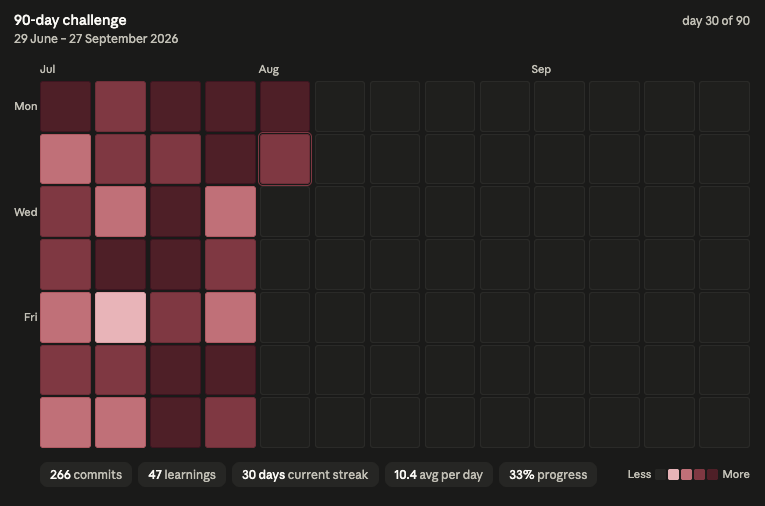
So this update covers what I actually built behind those bricks. What went well, what didn't, and what I've really learned now that the novelty has worn off and the routine has settled in. It also covers how the grimoire itself is taking shape: what's in it so far, what's changed since I started, and what's still missing.

What was built behind those bricks
I started with a brainstorm of what I actually wanted out of this challenge, and turned it into a set of key results: what I wanted to learn, which workflows I wanted to build, and how I was going to get there. From that, I mapped out a high-level 90-day plan.
From there I set up the grimoire itself, the website that holds this whole project. Next I built a knowledge system, designed to actually capture what I learn instead of losing it. This felt like the foundation for the challenge.
With a background in product, development, and design, I started building the workflows that were most relevant to my day to day work. Building and learning happened side by side: I'd take a course or pull in extra material while setting up the workflow itself, which meant I could test it in practice right away.
The concrete output of the last 30 days:
The foundation
A learnings map: a full overview of what I’ve picked up so far, plus a rough plan for the full 90 days of the challenge.
The grimoire documentation site: everything about my AI workflow comes together as I go at grimoire.esmeepeters.com.
A rebuilt knowledgebase system: redone from the ground up, with an actual workflow around it so it gets used instead of just existing.
The heatmap skill: generates a visual heatmap of my daily commits and learnings, so I can show the process straight inside the daily notes.
The workflows
A design system workflow: a structured way of working through design decisions, built from a learning path I set up for myself.
A design-skills repo: published publicly on GitHub, so anyone can copy the exact process I use.
The proof
Owly Post: an open source, self-hostable feed tool, built as the proof of concept for everything in this challenge.
A cloud version of Owly Post: a hosted, multi-tenant layer on top of the open source core, as a SaaS application.
An interactive landing page: an animated website that shows what Owly Post does and how to run it yourself.

Behind all the output
Beyond what I'm building for myself and others, I think we should be more open about the process itself, not just the polished outcomes. This field moves fast. Just keeping up, let alone implementing any of it, is close to a full time job. Nobody knows everything, it takes time and practice, and not everyone has the same hours to spend on it. And that is perfectly fine. What matters is that you're doing what works for you.
I wanted to get that off my chest first, because it matters to me.
The honest part
Time for an honest update on how this is actually going. Some days it flows. Other days I feel behind. Really behind. Everyone else seems to be shouting about the amazing things they’ve built with AI, making it look effortless, and making me feel insecure. And there's the impostor syndrome. Why would anybody care about me playing around with AI and documenting it?
And when I’m in that headspace and then also run out of credits, or some other small setback hits, that’s when I catch myself wishing I’d never started this challenge at all. But the fix is always the same: remind myself I have nothing to prove to anyone, and get back to being curious for my own sake. Worst case, I learned something.
So yes, I'm too hard on myself. Which is funny, because that's exactly what I set out to show: nobody has everything together. Turns out I'm my own best case study.
But here's the other side. I'm genuinely proud of myself. For years I'd thought about doing something like this. I badly wanted to build a product, help others with the things I made, and write articles. I never did. In the last 30 days, I finally made it happen. All of it.
What changed? I forced myself to produce output every day, even when it wasn't perfect. My open source project, cloud version included, simply got built. I stopped building for the money, or for the one perfect idea that changes everything. I stopped needing everyone to like it. I just built it.
That creates momentum. Having started is already half the work.
And the unexpected bonus: Substack. I feel like I've genuinely made some buddies. It's honestly so much fun. It feels like building, learning and growing together, and sometimes, when the impostor syndrome kicks in, I just think: keep going, my buddies will cheer me on. So, a huge shout out to everyone who supported me over the last thirty days.
Biggest lessons I learned
I learned a lot these last 30 days, mostly about development, because that's where most of my time went while building Owly Post.
Write requirements and specs before you build. It doesn’t just make you build twice as fast, it keeps you the one making the decisions, instead of reviewing what AI already decided for you.
Mark open questions as open questions. It happened to me a lot that unspoken doubts quietly turned into decisions. Write them down as undecided and put a stop rule around them.
Trust your gut. If something feels off while you're building, or you feel yourself losing grip on what's happening, it is off. That's a pattern, so listen to it: step back, get skeptical, and start asking questions.
Something I already knew going in, but that’s really starting to sink in now: this grimoire will never be finished. AI moves too fast for that, and 90 days is short. What’s there now is a surface level version of my workflow: the structure is in place, but the depth still needs to be added. That’s fine. It’s becoming a living document, one I’ll keep updating long after the remaining 60 days are over.
The grimoire: the manual for AI magic and sorcery
All the pieces of what I'm building come together here: grimoire.esmeepeters.com. It's starting to take shape. Currently it documents my knowledge system and design workflow.
Slowly it's becoming clear that the AI has to wrap around my workflow instead of sitting next to it. If I have to remember which skill to call for every possible situation, it simply won't happen.
That's how the grimoire works today: before I start, I have to think about what I'm doing and call the right skills myself. It also isn't sequential. One workflow doesn't stop where the next one begins, they complement each other.
So that's what I'm changing next: the AI should wrap around my work, not the work around the AI.

Finally
Over the remaining 60 days, I’ll keep working on the grimoire, with daily updates through notes and a more detailed checkpoint every 30 days: what got built, what worked, and what didn’t. That continues in parts III and IV.
The goal from the start was to become genuinely skilled at using AI, so it actually enhances what I’m doing instead of just prompting around in circles. I’ve made a lot of progress, but I don’t think I’m quite there yet.
So if you have publications or insights to share, please reach out. Learning shouldn’t happen in an ivory tower, I want to learn from you too and I’m genuinely open to feedback. I’m also happy to test your projects and give feedback in return. Just reach out.
And for now: happy building!

Really excellent roundup and I can see how cleverly you planned this 90 day challenge. All the pieces of the puzzle are complementary, fit neatly and are coming together. Thanks for sharing your learnings as you go along, it is really inspiring. And shucks, do I feel you when you mention imposter syndrome! But I really don't think you should have that feeling. You are the real deal....
This is a really comprehensive write up! You are making such good progress!